Queer Histories
The Monochrome Frame Project
The Old Mill Lane Project
Coming soon: 'ElDorado'

'The Monochrome Frame': mural making as a research method
Doctoral research into the experiences of queer (gay/bi men) who are educators
Using visual imagery to create new ways of seeing and a lens for analysis
Biddulph, M. (2005) The monochrome frame, mural-making as a methodology for understanding self, in Mitchell, C., Weber, S. and O’Reilly-Scanlon, K. (eds) Just who do we think we are? Autobiography and self-study in teaching, London: Routledge-Falmer
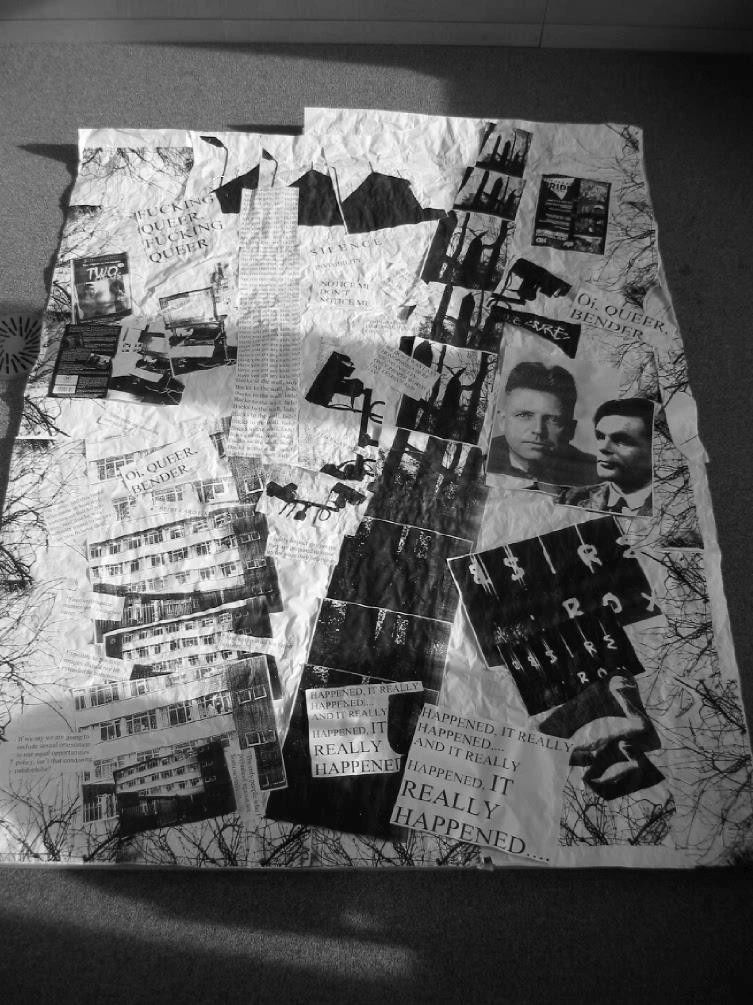
'The Monochrome Frame': mural making as a research method
In the period 1998-2005 I found myself immersed in doctoral study, researching the experiences of gay/bi men who are educators, curious about how they manage and perform their identities in the range of personal-professional spaces that they traversed in their lives. In sharing their experiences, my participants were generous to a tee which produced the interesting situation of being awash with data which although wonderful, then produced a new challenge of how to undertake some sort of meaningful analysis to elicit the key themes in their stories.
One day I happened across Douglas Harper’s insightful paper (Harper, 2002) in which he proposed ‘that photo elicitation enlarges the possibilities of conventional empirical research…photo elicitation also produces a different kind of information…evokes information, feelings, and memories that are due to the photograph's particular form of representation’. I had found my way in – I needed a mural on which I could juxtapose extracts from my story, participant’s stories and images of the spaces we traversed.
Two stages lead to the construction of the mural. The first involved the acquisition and use of black and white photographs, a technique for which I am indebted to Mignot, (2000). I set off with a camera loaded with black and white film to photograph a series of sites and images that represented ideas that I had about the gay teacher experience. Some sites were chosen as the exact locations of my direct experience - others were chosen more for their representational or image potential. The sites representing education experience were fairly easy to locate, being mainly located in the secondary school in which I was then working. The sites representing gay identity were more problematic. How is it possible to represent the gay aspect of my experience in terms of photographic imagery? At this time, I had become intrigued by the notion of how geographical space is delineated in terms of sexualities. Brent Ingram, Bouthilette and Retter (1997) argue that some geographical spaces function as sites of resistance for the ‘queer community’. This is an important influence in the design of the mural and informed my thinking on how I used different areas of the canvas to reflect different discourses relating to sexuality and identity.
Arguably, a range of gay community spaces exist ranging from bars, pubs and clubs of the ‘commercial gay scene’ to more liminal spaces frequented by men who have sex with men, such as public parks and cruising areas. In selecting a representational space I chose the latter, photographing a cruising area located on a canal towpath that flanks a public park in an inner-city area. The location is rich in imagery – the stark winter landscape produced some striking images that were powerfully captured by the black and white film.00000000
Creating a montage
The second stage was the actual physical construction of the mural in the form of a montage, together with the acquisition of a purpose-built cardboard box for its transportation, brought some interesting learning about the intrinsic interest and curiosity that individuals have in visual imagery, ‘story’ and the contents of large cardboard boxes! The following anecdotes illustrate what I mean.
I began working at the photocopier at my university base and from the outset those around asked questions about what I was doing – the photographs interested them as did the enlarging/reducing activity. The same phenomenon also manifested itself when I began to assemble the mural in an empty teaching room. Students with whom I had never had conversations, came to look and ask questions about what I was doing. I can vividly recall the energy and strong feelings that the process generated. The power of the activity gripped me like a drug and I became aware of a rising tide of anger triggered I suspect, by the material that I was handling. I started at about 3.00pm with the intention of going home at 5pm. I was still there at 8.30pm and the process seemed to take on a momentum of its own.
The level of interest did not stop there either. Some months later, I transported the mural in its box to the European Conference of Education Research held in Edinburgh 2001. Again, the questions came thick and fast from airline check-in staff and taxi drivers alike. ‘What was in the box?’ ‘What did I mean by my story?’ The experience was challenging. What should I disclose? What should I not disclose? In retrospect, the prominent labels on the box that read ‘fragile’ and ‘passenger baggage’ had more than a little irony.
Immediate learning: surfacing conscious awareness
In constructing the mural, I began by constructing a visual framework that surrounds the whole piece. At first glance the imagery is one of a fretwork – I created the image by photocopying and enlarging a photograph that I took of the winter sky as seen through the bare branches of trees. The effect gives the mural an enclosed, contained feel – this has metaphorical as well as visual significance, an issue I will return to later.
The main canvas of the mural consists of two main parts representing teacher experience and gay experience; I used the image of the park railings crossing diagonally from one corner to another to separate the two. The use of the park railings photograph immediately struck me in terms of its potential for representing the interface between the two aspects of experience. The railings themselves in physical terms are a permeable barrier – it is easy to see through them to the environment on the other side. The implications of this in metaphorical terms, is that the notion of permeability opens up the potential for movement from one side to the other with all the implications for identity, context and movement in writing an account of participant’s stories.
I was interested in two other photographic images that I acquired on the canal towpath. Apart from maintenance of the railings, there was other evidence that the local authority had taken measures to deter the nocturnal activity of cruising men. Considerable remedial work was being undertaken on the towpath including the cutting back of trees and the installation of CCTV on the approach to the canal from a street nearby. Someone had sprayed the phrase ‘crude cure’ on a concrete wall adjacent to the towpath – this may or may not have connection with the clean-up campaign and it struck me as an interesting statement in that context. If I am honest, it quite appeals to my sense of the transgressive or subversive. 000
This mural became a game changer - I had found my way in and I could move forward! An unexpected outcome was my liking of it as a piece of art. In retrospect, it was definitely an antecedent of my post-retirement artistic endeavours.
In case they’re of interest, the sources cited above are:
Brent Ingram, G., Bouthilette, A. and Retter, Y. (1997) Queers in Space: Communities, Public Places, Sites of Resistance, Seattle: Bay Press
Harper, D. 2002. Talking about pictures: a case for photo elicitation. Visual Studies Volume 17, Number 1
Mignot, P (2000) Using visual methods in careers education and guidance, Pastoral Care in Education, June 2000
The Old Mill Lane project
Gay/Bi men and encounters with the law in the 1960s UK
A primary research project based on interviews and newspaper archives
Beginning as a piece of performance
'Contagion' and 'The Road to Ruin'
Queer Histories: 'The Old Mill Lane Project'
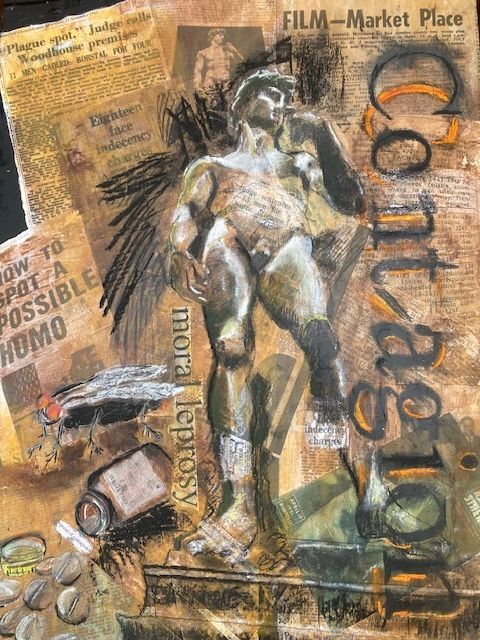
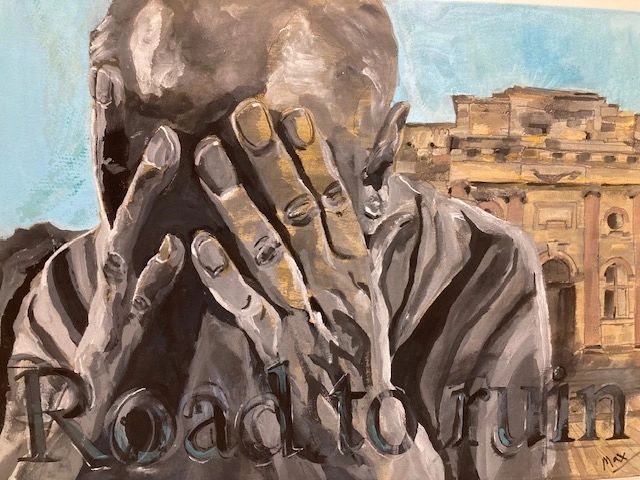
Nottinghamshire’s Queer History and discourse in image making: ‘Contagion' (montage in mixed media on board) and ‘The Road to Ruin’ (acrylics on canvas) by Max -Instagram: ‘Art_in_Max_’.
Thanks for spending a few minutes viewing these two pieces. In case you’d like to know a little more about their context, please read on…
1961 as the context
Both images were created from research into a now infamous (but not unusual for the time) trial, of twenty-three men accused of gross indecency (sexual relations between men) at Nottingham Assizes, now The National Justice Museum, High Pavement, Nottingham, in November 1961. A chance conversation with ‘a friend of a friend’ now in his mid-eighties, alerted me to the ripples from this event in Nottingham’s gay men’s community at the time, which was the trigger for my research.
Four years earlier in 1957, The Report of the Departmental Committee on Homosexual Offences and Prostitution, otherwise known as The Wolfenden Report, was published in the United Kingdom after a succession of high profile figures including Lord Montagu of Beaulieu, Michael Pitt-Rivers, John Gielgud, and Peter Wildeblood were also convicted of gross indecency. In the wake of the report, the decade 1957-67 was a period of rumination and debate and by 1961 the public appetite for law reform had not yet gained sufficient traction to generate the legislative change that parliament could enact, hence the on-going prosecutions.
The Police raid at the house on Old Mill Lane, Mansfield Woodhouse Acting on intelligence gained from a previous conviction in Alfreton, Nottinghamshire Police raided a Sunday afternoon ‘party’ being attended by a large group of men. Reports in the local press quote (so using the language of the time) officers encountering ‘a disorderly house run by a coloured man who had subsequently absconded’. The evidence for the case for prosecution that was subsequently assembled comprised interviews with defendants and consequent ‘confessions’, scrutiny of personal diaries/address books and reviews of previous convictions. The accused faced 66 charges and asked for 96 further offences to be taken into consideration. One man was found unconscious on the floor upstairs having taken phenobarbitone tablets. Press coverage of the trial which lasted over two days included publication of full names, addresses and occupations of the 23 accused. In total 13 men were sentenced to terms of imprisonment varying between three years and one year, and four others were sent for borstal training.
Discourse as a stimulus for visual thinking
Discourse can simply be defined as the structure of language in terms of the vocabulary choices we all make in day-to-day communication. The assertion that these are ‘only words’ is naive, most language being permeated by personal values and political beliefs, societal values, emotion, ‘world view’, philosophy even…
Press reports of the trial provide a rich (and distressing) pool of material for visual interpretation. An example is the commentary of the judge Mr Justice Stable, who is quoted as saying: ‘(sexual relations between men) are “the road to ruin and disaster”. My duty is plain – “to stop the spread of contagion of this moral leprosy”.
‘Contagion' In this montage I have worked with the conversation had with the ‘friend of a friend’ who reported a contradiction he experienced at the time. Simply put, this was between the fear and distress caused by the fallout from the trial (a potent reminder of the need to police identity, disclosure and behaviour in all social environments) versus notions of self-affirmation, pleasure and the need to function on a day-to day-basis.
On the right-hand side is material that reflects positive influences e.g. coded contact ads from ‘Film Monthly’, a homo-erotic cover page from ‘Health and Strength’ magazine and the sheer beauty of Michelangelo’s ‘David’ (a light-bulb in my own personal journey as a gay man). In contrast, on the left-hand side are press cuttings of the trial as well as wider coverage of the Wolfenden debate.
‘Road to ruin, 1961’
In this image I imagine the impact on the 23 accused. A visit to The National Justice Museum in Nottingham today reveals the intimidating nature of this building, defendants being led up from the cells via a narrow staircase directly into the panelled courtroom chamber. The Nottingham Guardian Journal reported that one of the accused, a twenty-year old man from Bilsthorpe, collapsed when sentenced to 12 months imprisonment and had to be helped from the court. Apart from the trauma of such public shaming, the damage to reputation and employment prospects, the risk of social ostracization made such draconian sentencing a real ‘road to ruin’. In constructing the image, I want the viewer to consider the question of ‘where does the pathology lie: in the individual accused or in the attitudes of the time?’
Postscript
In December 2023, The Chief Constable of Nottinghamshire, Kate Meynell, became the eighth UK police chief to offer an apology to the LGBT+ community. Writing to Peter Tatchell, she said: “Our past actions, as well our inaction, has caused members of our LGBT+ communities to feel aggrieved, angry and upset, often by the interpretation and action we have taken in enforcing the law on what would now be rightly recognised as being discriminatory processes and procedures. For this I apologise for the hurt caused.”
Coming soon: 'ElDorado'
A narrative of 'othering' 1924-44
Triptych in mixed media and found objects
Premiere: 16-21 November, 2026, 10am-6pm, ‘Newstead Art Classes Show 2026’ @ Nottingham Society of Artists, St Luke’s House, 71-73 Friar Lane, Nottingham. NG1 6DH
artinmax